We made it!
We finally got planning permission for Cricklade and St Hugh’s. Both took a lot longer than anyone outside the process would guess, and both were worth the wait. Here is what goes into getting a padel site through planning, why it drags, and why we keep doing it.
Planning runs on its own clock
The council has a statutory target to decide most applications like ours in 8 weeks, and 13 weeks for anything classed as major development. In practice almost nobody hits those dates. The council asks for an extension of time, the caseworker has forty other files on the desk, a consultee comes back late, and 8 weeks becomes five or six months without anyone doing anything wrong.
Before the clock even starts, the application has to be validated. Miss a drawing or a report and it sits in a queue until someone flags it. We build in weeks for that before we count a single day of the formal period.
So the honest answer to “how long does it take” is this: budget six to twelve months from first drawing to a decision you can build against. Cricklade and St Hugh’s both sat inside that range.
The issues that actually slow it down
For padel, noise is the one that comes up every time. The sound of the ball off the glass carries, and neighbours know it. We commission an acoustic report up front, design the courts and the hours around it, and answer the objections before they turn into a refusal. Skip that and you hand the council an easy reason to say no.
After noise, the usual suspects:
- Highways and parking. The council wants to know cars are not going to spill onto a residential street.
- Ecology and biodiversity. Net gain rules mean you often need an ecologist and a plan to leave the site better than you found it.
- Drainage, lighting, landscaping. Each one can trigger its own report and its own consultee.
Then there are objections from neighbours, which are part of the process and worth taking seriously rather than dismissing. A site that answers the objections honestly gets through. One that ignores them gets called in.
Getting the grant is not the finish line
A permission almost always comes with conditions attached. Some of them stop you starting, which means you cannot put a spade in the ground until the council has signed them off. Clearing conditions is its own small application with its own wait. Cricklade and St Hugh’s both carry conditions we are working through now, and we planned the build around clearing them rather than assuming day one starts the moment the decision arrives.
What it costs
The application fee is the small part. The real spend is the team you need to get a clean decision: a planning consultant running the file, plus acoustic, transport, ecology, drainage and landscape input depending on the site. On a padel scheme that adds up before you have laid a single court.
The cost people forget is the carry. A site under offer or on a lease is costing you something every month it sits in planning and earns nothing. Twelve months of that is real money, and it is the number that makes founders impatient.
Why we keep doing it
Every one of our sites started as a slow, expensive planning file. Six are now open and trading. The wait is the price of a location that works, and a location that works pays for the wait many times over. Our model runs on leases pegged to revenue and a low cost base, so once a court is live it earns for years. A few months of patience against a lease that runs a decade or more is a trade we take every time. We have six more to finish this process!
Cricklade and St Hugh’s are two more that made it through. On to the build.
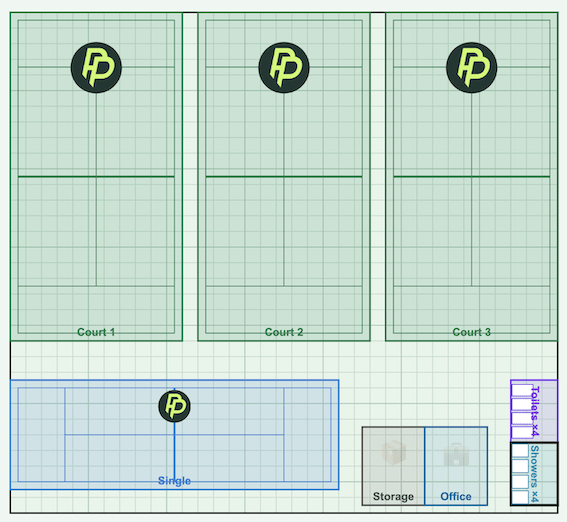
We actually made our own court planner to speed things along! This is the pic!